
If you’re confused about how 1 CBM to KG in sea freight works, you’re not alone. Many importers and exporters struggle to understand how shipping companies convert volume into weight. Knowing this calculation can help you avoid extra charges and plan your costs better. In this guide, we’ll break it down in simple words so you can easily calculate freight weight and ship smarter without any surprises.
Understanding CBM
So, we know that CBM is all about space, but how do you figure it out? It’s much easier than you might think! You don’t need to be a math genius or have a fancy calculator. All you need are three simple measurements: length, width, and height.
How is CBM Calculated?
Imagine you have a regular cardboard box. To find its CBM, you just measure its length, width, and height in meters. Once you have those three numbers, you multiply them together. That’s it!
Length (m) x Width (m) x Height (m) = CBM
For example, if your box is 1 meter long, 1 meter wide, and 1 meter tall, you get 1 x 1 x 1 = 1 CBM. It’s like building a cube with toy blocks. You’re just measuring how many one-meter blocks would fit inside your shipment’s space. If you have ten identical boxes, you just calculate the CBM for one box and multiply it by ten. Easy peasy!
Why is CBM Important for Sea Freight?
Now, let’s talk about why this is a huge deal for shipping things on a boat, which is called sea freight. A cargo ship is like a giant floating puzzle. The crew has to fit thousands of boxes and items from different people into a limited space. Knowing the exact CBM of each shipment helps them plan perfectly.
Think about it: if they didn’t know the size of everything, they might run out of room before all the packages are loaded. Or, they might leave big empty spaces, which is just a waste. By using CBM, they can stack everything efficiently, making sure every inch of the ship is used wisely. This helps keep shipping costs fair for everyone and ensures your package gets on board without a hitch. It’s all about making the puzzle work
CBM and Freight Costs
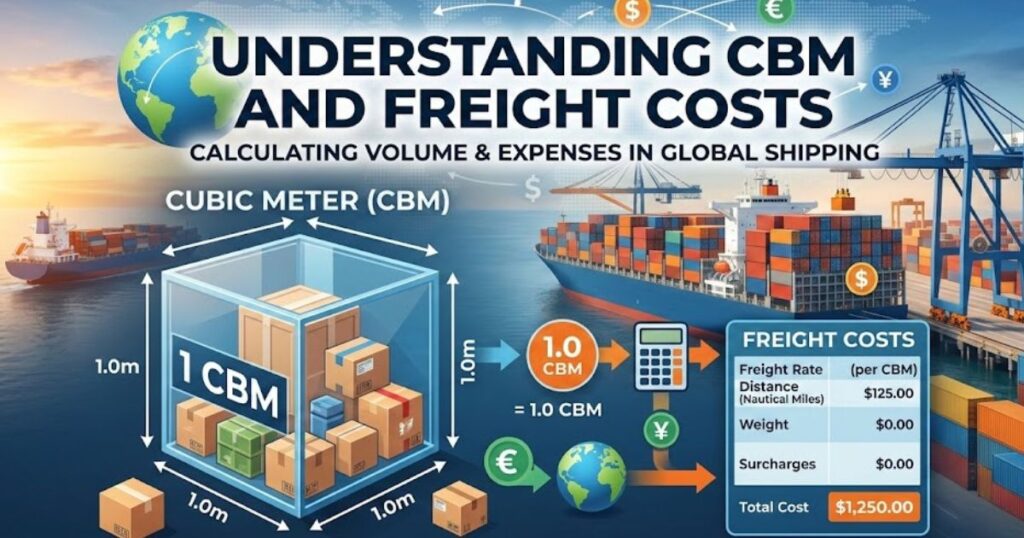
Okay, let’s talk money! We all want to save our allowance, right? When you are shipping things, understanding how CBM works is like finding a secret coupon code. It can actually help you pay less for moving your stuff from one place to another. But watch out—if you ignore it, you might end up paying for air!
How Does CBM Affect Freight Costs?
Imagine you are buying a bag of potato chips. You know how sometimes the bag is huge, but when you open it, it’s half empty? You paid for the big bag, even though there weren’t that many chips inside. Shipping works the same way.
If your package is big and fluffy (like a giant beanbag chair), it takes up a lot of space on the ship. The shipping company can’t put anything else in that spot. So, even if the beanbag is light, they have to charge you for the space it steals. That is where CBM comes in. The more cubic meters your cargo takes up, the more it usually costs. It’s the rule of the sea!
CBM vs. Volumetric Weight vs. Chargeable Weight
This part sounds like a tongue twister, but stick with me! It’s actually pretty simple.
There are two ways the shipping company looks at your box:
- Actual Weight: How heavy is it really? (Like stepping on a bathroom scale).
- Volumetric Weight: How heavy does it look based on its size?
The shipping boss looks at both numbers. If your box is light but huge, the volumetric weight will be high. If your box is tiny but full of bricks, the actual weight will be high.
Here is the catch: they will always charge you for whichever number is bigger! This final number is called the Chargeable Weight. So, knowing your CBM helps you figure out if you are being charged for weight or for space. It’s like a game of “Highest Number Wins,” and you want to be ready for it.
How to Optimize Freight Costs Using CBM?
Now for the secret tip! If you are shipping something, you don’t want to pay for empty air.
Let’s say you are shipping a bicycle. If you ship it fully assembled, it takes up a lot of CBM because of the handlebars and pedals sticking out. But, if you take it apart and pack it flat in a smaller box, the CBM goes way down!
By packing your things tightly and smartly, you reduce the space they take up. Less space means a lower cost. It’s like packing your school bag perfectly so you can fit your lunchbox, books, and gym shoes without squishing your sandwich. Smart packing equals smart saving!
Practical Applications of CBM
Alright, now that we’re CBM experts, let’s see how this magic measurement works in the real world. Think of it as a superpower that helps you make smart choices when you’re sending your packages on a big adventure across the globe. Knowing your shipment’s size helps you decide how it should travel.
CBM for LCL (Less than Container Load) Shipments
What if you only have a few boxes to send? You don’t need a whole giant shipping container for that! This is where LCL shipping comes in. LCL stands for “Less than Container Load,” and it’s like carpooling for your cargo. Your boxes get to share a container with packages from other people.
In this situation, your CBM is super important. Since you’re only paying for a small part of the container, the shipping company will charge you based on the exact amount of space your boxes use. If your cargo has a small CBM, your cost will be lower. It’s the fairest way to share the space and the cost, making it affordable to ship even small quantities.
CBM for FCL (Full Container Load) Shipments
Now, let’s say you’re moving your whole bedroom or sending a massive order for your new toy store. You’ll probably need an entire container just for your stuff. This is called FCL, or “Full Container Load.”
You might think that CBM doesn’t matter here since you’ve rented the whole container. But it’s still your secret weapon! By calculating the total CBM of all your boxes, you can figure out which container size is perfect for you. Containers come in different sizes, like 20-foot or 40-foot. If your total volume fits in a smaller container, you can save a lot of money instead of paying for a big one with wasted space. It’s about picking the right size lunchbox for your sandwich!
CBM for Air Freight vs. Sea Freight: Which is Better?
Imagine you need to send a birthday present to a friend who lives far away. Should you send it on a super-fast airplane (air freight) or a slow-and-steady ship (sea freight)? Your CBM can help you decide.
Airplanes have very limited space, so they are extra sensitive to bulky items. A large, lightweight box will be very expensive to send by air because it takes up so much precious room. In this case, even if it takes longer, sending it by sea might be much, much cheaper because ships have tons of space. By comparing the cost based on the package’s size, you can choose the best and most cost-effective way to get your gift delivered.
Tools and Resources
Now that you’re a shipping genius, you deserve some awesome gadgets to make your job even easier! Just like a superhero has a utility belt, you can have a set of tools to help you conquer the world of shipping. These resources will make calculating your cargo’s size a breeze, so you can spend less time doing math and more time planning your next big shipment.
Free CBM Calculator: How to Use It Effectively
What’s better than a cool tool? A free one! There are tons of CBM calculators online that do all the hard work for you. Think of it as a magic wand. You just wave your measurements over it, and poof!—it tells you the answer.
Using one is super simple. You’ll see boxes for length, width, and height. Just type in your numbers, make sure you have the right units (like meters or centimeters), and hit the “calculate” button. The calculator will instantly give you the CBM for your package. Some even let you add the number of boxes you have, and they’ll figure out the total volume for your entire shipment. It’s a fantastic way to double-check your own math and feel extra confident before you book your cargo.
Top Tools for Freight Planning and CBM Calculation
Beyond a basic calculator, there are other cool tools that can help you become a master planner. Some websites offer freight planning tools that are like playing a video game. You can enter the CBM of all your different items, and the tool will show you a 3D picture of how they can fit inside a shipping container.
This is incredibly helpful because it shows you the best way to stack your boxes to use every last bit of space. You can move things around, try different arrangements, and find the perfect fit. It helps you avoid paying for empty air and ensures you choose the right size container. Using these tools makes freight planning feel less like a chore and more like solving a fun puzzle. Getting your CBM right is the first step, and these resources make that step a piece of cake.
Conclusion
You made it! You now know the secret language of shipping. Understanding CBM is like having a superpower that helps you pack smarter and save money. Whether you are sending a tiny toy or a giant sofa, you can now plan your shipment with total confidence.
Remember, it’s not just about weight—space matters too! So, next time you need to send something special across the ocean, grab your measuring tape and put your new skills to work. Happy shipping, future captain!
FAQs
How Many KG is 1 CBM in Sea Freight?
This is a fantastic question! Think of it as a golden rule for sea shipping. For most sea freight shipments, 1 CBM is considered to be equal to 1,000 kilograms (kg).
Why so heavy? Imagine a big, empty box that is one meter on all sides (that’s 1 CBM). A shipping company needs to make sure they get paid fairly, whether that box is filled with pillows or heavy books. So, they created this rule. Even if your 1 CBM box only weighs 200 kg, they will charge you as if it weighs 1,000 kg. It helps balance out all the light, bulky items with the small, heavy ones on the ship
What is the Difference Between CBM and Volumetric Weight?
This one can be a little tricky, but let’s break it down. CBM is simply the measurement of the space your package takes up. It tells you the size.
Volumetric weight, on the other hand, is a pretend weight that is calculated based on that size. Different shipping methods (like air or sea) use different secret formulas to turn the CBM into a weight. They then compare this pretend weight to the actual weight of your box and charge you for whichever is higher. So, CBM measures the space, and volumetric weight turns that space into a number that can be compared to actual weight.