
Shipping goods between China and Pakistan has become faster and more efficient than ever, thanks to professional freight forwarding services. A reliable freight forwarder ensures smooth handling of cargo, from pickup and documentation to customs clearance and final delivery. Whether you are an importer, exporter, or eCommerce seller, choosing the right partner can save time and reduce costs. With strong logistics networks and expertise in international shipping, these services offer both air and sea freight solutions. The result is a hassle-free experience that keeps your business moving without delays.
Why Pakistan Relies Heavily on Chinese Imports
Here’s a number that’ll blow your mind: China accounts for nearly 29% of Pakistan’s total imports. That’s almost 1 in every 3 products Pakistan brings in from the world coming from China.
And it makes sense. Chinese factories produce everything textiles, electronics, machinery, furniture, plastic goods, auto parts — at prices that Pakistani markets genuinely can’t match locally. Bilateral trade between the two countries crossed $26.5 billion in 2023, and that number keeps climbing.
Then came CPEC the China-Pakistan Economic Corridor. This massive infrastructure project didn’t just build roads and power plants. It rewired how goods move between the two countries. New ports, new highways, new rail links. For Pakistani traders and business owners, CPEC opened doors that didn’t even exist a decade ago.
So whether you’re importing 500 units of phone cases or 3 full containers of machinery, the China-Pakistan trade route is one of the most active commercial corridors in Asia. And navigating it well starts with one decision choosing the right freight forwarder.
What Does a Freight Forwarder Actually Do?
Think of a freight forwarder like a travel agent but for your cargo.
You don’t call the airline yourself, book the hotel yourself, arrange the visa yourself, and figure out the local transport yourself. You call one person who handles all of it. That’s exactly what a freight forwarder does for your shipment.
Here’s what they actually take care of:
- Picking up your goods from the Chinese supplier
- Booking space on ships, planes, or trains
- Preparing all your shipping documents
- Clearing customs on both ends
- Delivering the cargo to your door in Pakistan
Now, here’s a distinction that confuses a lot of first-time importers. A freight forwarder manages the entire logistics chain. A customs broker only handles customs clearance. A shipping agent only books cargo space. A good freight forwarder covers all three which is why finding the right one is so important.
If you’re based in Karachi or Lahore and importing for the first time, a full-service freight forwarder isn’t a luxury. It’s the smartest investment you’ll make before your goods even leave China.
Ways to Ship Goods from China to Pakistan
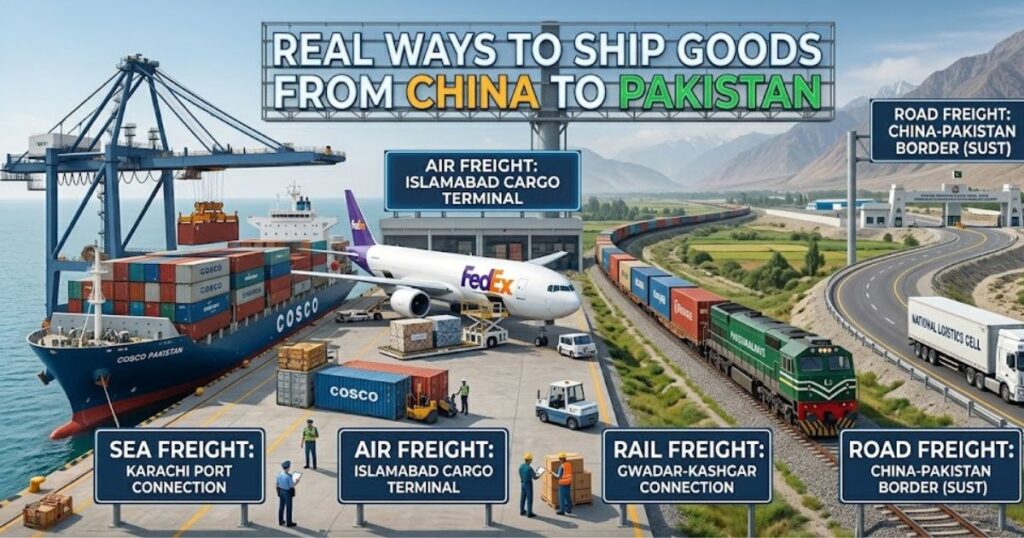
Not all shipping is created equal. The method you choose affects your cost, your timeline, and your stress levels. Here are your 4 options — broken down simply.
Sea Freight Best for Bulk and Cost-Conscious Importers
Sea freight is the backbone of Pakistan-China trade. If you’re shipping large volumes, this is almost always your best bet.
Your cargo will travel from major Chinese ports Shanghai, Shenzhen, Ningbo, or Qingdao and arrive at one of three key Pakistani ports. Karachi Port handles over 60% of Pakistan’s imports. Port Qasim handles deep water containers. And Gwadar, powered by CPEC, is the rising star of the three.
Transit time runs 20 to 30 days. Not the fastest, but the cost savings are significant especially for heavy or bulky goods.
You’ll hear two terms a lot: FCL (Full Container Load) and LCL (Less than Container Load). FCL means you fill the whole container great if you have enough volume. LCL means your cargo shares space with others perfect for smaller shipments.
Air Freight For Urgent and High-Value Cargo
Need it fast? Air freight gets your goods from China to Pakistan in 3 to 7 days. The 3 main Pakistani airports handling international cargo are Karachi, Lahore, and Islamabad.
This option makes sense for electronics, fashion, medical supplies, or anything time-sensitive. The cost runs around $4.5 to $7 per kilogram so it’s not cheap. But when speed matters more than saving money, air freight delivers.
Rail Freight via CPEC The Emerging Alternative
This one’s exciting. Thanks to CPEC, rail freight from Chinese cities in Xinjiang now connects directly into Pakistan through the Khunjerab Pass. It’s faster than sea, cheaper than air, and it’s only going to grow in the coming years.
If you’re importing into northern Pakistan Islamabad, Peshawar, or Gilgit keep a close eye on this route. It’s genuinely changing the cost equation for Pakistani importers.
Road Freight via Karakoram Highway
The legendary KKH connecting Pakistan to China through some of the world’s most dramatic mountain roads. Road freight works well for smaller loads heading into northern Pakistan. It’s flexible, relatively affordable, and surprisingly reliable for the right type of cargo.
Shipping Costs from China to Pakistan Full Breakdown
Let’s talk money because this is where most importers get caught off guard.
But here’s the thing nobody warns you about the hidden fees.
Port handling charges. Documentation fees. Customs examination charges. Demurrage (that’s what they charge when your container sits too long at port). Fuel surcharges. These extras can add 15% to 30% on top of your base quote.
Always ask your freight forwarder China to Pakistan for an all-inclusive quote. If they can’t give you one, that’s a red flag which we’ll cover later.
What Documents Do You Need to Clear Customs in Pakistan?
This is the question that keeps importers up at night and rightfully so. Missing or incorrect documents can hold your shipment at port for days, sometimes weeks. And every extra day costs money.
Here’s your essential documents checklist:
- Commercial Invoice shows the value, quantity, and description of goods
- Packing List details every box, its weight, and contents
- Bill of Lading (for sea) or Airway Bill (for air) your proof of shipment
- Certificate of Origin proves your goods came from China
- HS Code Classification the product code that determines your duty rate
Getting your HS Code wrong is one of the most expensive mistakes you can make. It can trigger higher duty rates or even a customs inspection. Your freight forwarder should help you classify your goods correctly if they can’t, find one who can.
One thing most competitors won’t tell you: Pakistan’s FBR (Federal Board of Revenue) has an online portal called WeBOC (Web Based One Customs) where all import declarations are filed electronically. A good freight forwarder will handle this for you, but knowing it exists means you can ask the right questions.
Pakistan Customs Duties, GST and Import Taxes Explained
Nobody loves paying taxes. But understanding them upfront saves you from nasty surprises when your cargo arrives.
Here’s how Pakistan’s import tax structure works:
- Customs Duty: varies by product, typically 2% to 50% of the goods’ value
- GST (General Sales Tax): a flat 17% applied on top of the customs duty-paid value
- Regulatory Duty: an additional charge on certain categories
Now here’s the good part the China-Pakistan Free Trade Agreement (FTA). Under this agreement, 75% of tariff lines carry zero duty for Chinese goods entering Pakistan. That means a huge range of products textiles, machinery, electronics components come in at 0% customs duty.
This is money most importers are leaving on the table simply because they don’t know to ask for it. Make sure your freight forwarder knows how to apply FTA benefits correctly on your shipment documents.
Halal Certification What Pakistani Importers Must Know
If you’re importing food products, cosmetics, or health supplements from China, this section is non negotiable.
Pakistan requires that all imported food and cosmetic products meet the standards of the Pakistan Halal Authority (PHA). That means your Chinese supplier must provide valid Halal certification and it must be from a body that PHA recognises.
Skip this, and your goods won’t clear customs. Simple as that.
Here’s what to do before you ship: ask your Chinese supplier for their Halal certificate, verify the certifying body is PHA-approved, and attach it to your commercial invoice packet. Your freight forwarder China to Pakistan should flag this requirement automatically if they don’t, that tells you something about how well they know Pakistan-specific regulations.
Incoterms Simply Explained for Pakistani Importers
Incoterms sound terrifying. They’re not. They’re just agreed rules that define who pays for what — and who’s responsible when something goes wrong.
Here are the 4 you’ll encounter most:
- EXW (Ex Works): You handle everything from the factory gate. Maximum control, maximum responsibility.
- FOB (Free on Board): Supplier gets goods to the Chinese port. You handle everything after that.
- CIF (Cost, Insurance, Freight): Supplier covers shipping and insurance to Pakistan port. You handle customs and delivery.
- DDP (Delivered Duty Paid): Supplier or forwarder handles everything all the way to your door in Pakistan, duties included.
For first-time importers, DDP is becoming increasingly popular in Pakistan especially among Karachi based SMEs because there are zero surprises. One price, door to door.
How Do You Choose a Reliable Freight Forwarder from China to Pakistan?
This is the most important question in this entire guide. Get this right, and everything else falls into place.
Here’s your checklist:
Green Flags look for these:
- Licensed with FIATA or IATA (international freight standards)
- Has a Pakistan-based local partner for customs and last-mile delivery
- Provides a transparent, fixed quote upfront no surprise fees
- Offers real-time cargo tracking
- Knows Pakistan’s WeBOC system and FBR requirements
- Can provide references from Pakistani clients who’ve used their service
Red Flags — walk away if you see these:
- Quote changes after you’ve paid a deposit
- No verifiable physical office in China
- Can’t explain your HS code or FTA benefits
- Pushes payment through informal channels
- No knowledge of Halal certification requirements for Pakistan
The best freight forwarder China to Pakistan will feel less like a vendor and more like a partner. They’ll anticipate problems before they happen and keep you informed every step of the way.
Common Scams Pakistani Importers Face And How to Avoid Them
This section doesn’t exist on any competitor’s website. But it should because these scams are real and they’re costing Pakistani importers millions every year.
The Ghost Forwarder: A company with a professional website, zero physical presence, and a disappearing act once your money is transferred. Always verify with a video call and ask for their business registration number.
Bait-and-Switch Pricing: You’re quoted $1,100 for a container. By the time your goods arrive, mysterious “extra charges” push it to $1,800. Always get every charge in writing before booking.
Under-Invoicing Pressure: Some forwarders suggest declaring a lower value to reduce customs duty. This is illegal. FBR penalties and cargo seizure are not worth the saving.
Fake FTA Benefits: Being told your goods qualify for zero duty under the China-Pakistan FTA when they don’t leading to underpayment and penalties on arrival.
How CPEC is Changing the Game for Pakistani Importers
CPEC isn’t just a political talking point. It’s a genuine infrastructure revolution that’s making importing from China faster, cheaper, and more accessible for Pakistani businesses of all sizes.
New highways have cut road transit times. Gwadar Port gives Pakistan direct Arabian Sea access reducing dependency on longer, more expensive routes through other ports. Rail links through Khunjerab are bringing northern Pakistan closer to Chinese manufacturing hubs than ever before.
For small and medium businesses in Pakistan, the opportunity is real. Lower freight costs mean more competitive pricing. Faster transit means less capital tied up in goods in transit. And as CPEC continues to develop through 2025 and beyond, these advantages will only grow.
City by City Delivery Guide for Pakistan
Where you’re based in Pakistan actually matters a lot for your shipping strategy.
- Karachi: Fastest customs clearance, most freight forwarder options, home to Pakistan’s biggest dry ports
- Lahore: Strong inland connectivity, benefits from Wagah border crossing for road freight, major air cargo hub
- Islamabad/Rawalpindi: Air-dominant route, growing bonded warehouse infrastructure
- Peshawar: Ideal for CPEC road freight from northern China
- Faisalabad & Multan: Last-mile delivery relies on inland container depots — build extra 2 to 3 days into your timeline
Conclution
A reliable freight forwarder from China to Pakistan plays a vital role in ensuring smooth and efficient trade operations. It simplifies complex shipping processes, from documentation to customs clearance and final delivery. With professional handling, businesses can avoid delays, reduce risks, and manage costs effectively. Choosing the right logistics partner also improves delivery timelines and customer satisfaction. In the end, a trusted freight forwarder becomes a key asset for consistent and successful international shipping.
FAQs
How long does shipping from China to Pakistan take?
Shipping time depends on the method you choose. Air freight usually takes 3–7 days, while sea freight can take 15 35 days depending on the port and customs clearance process.
What documents are required for freight forwarding?
Common documents include a commercial invoice, packing list, bill of lading or airway bill, and any required import/export permits. A professional freight forwarder helps manage all paperwork smoothly.
How much does it cost to ship from China to Pakistan?
Costs vary based on cargo size, weight, shipping method, and delivery speed. Air freight is faster but more expensive, while sea freight is cost-effective for larger shipments.