
China to Pakistan ExWorks Sea Air Cargo Trusted Service is a smart logistics solution for importers who want balanced speed and cost efficiency. It combines sea freight affordability with air freight speed to reduce delivery time compared to standard shipping. With ExWorks terms, suppliers prepare goods at their warehouse while the freight forwarder manages pickup and transport. This method is ideal for businesses needing reliable and flexible cargo movement from China to Pakistan.
What EXW Actually Means for Pakistani Importers
EXW (Ex Works) shipping from China to Pakistan is an Incoterm where the seller’s only obligation is to make goods available at their factory or warehouse. The buyer that’s you is responsible for everything from that point forward: arranging inland transport to the Chinese port, export customs clearance, ocean or air freight, Pakistani import clearance, and final delivery.
In plain terms: the price your supplier quoted is just the product. Every single rupee after that is your problem.
This is the most importer-heavy arrangement in global trade. Many Pakistani buyers discover this only after their supplier refuses to arrange a shipping quote — because under EXW, it’s not their job.
EXW vs FOB vs DDP: Which Should You Actually Use?
This is where most guides go quiet. They list the definitions but don’t tell you which one to choose.
Quick Comparison
| Incoterm | Best For | Key Benefit | Limitation |
| EXW | Experienced importers with their own freight agent in China | Lowest factory price | You handle Chinese export clearance complex for new importers |
| FOB | Most Pakistani SME importers | Supplier handles Chinese port delivery; you handle sea/air from there | Still leaves Pakistan customs entirely to you |
| DDP | First-time importers or high-risk goods | Fully inclusive, predictable total cost | Most expensive upfront; less control over routing |
| DDU | Mid-sized businesses with a trusted customs agent | Balance of cost and control | Pakistan customs risk still sits with you |
FOB is the sweet spot for most buyers sourcing through Alibaba. Your supplier delivers to the port in Shenzhen or Shanghai. You take over from there.
Sea Freight from China to Pakistan: What It Actually Costs
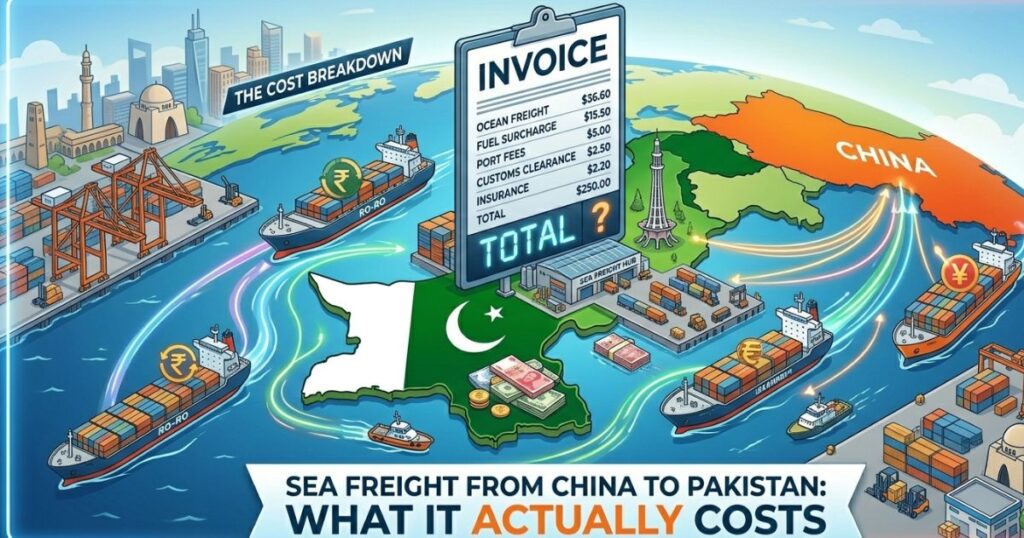
Sea freight from China to Pakistan typically takes 18–35 days, depending on container type, port of loading, and seasonal surcharges.
But that headline number hides the real structure. Here’s what Pakistani importers actually pay:
Cost Breakdown Sea Freight (FCL 20ft container, Shanghai to Karachi)
- Ocean freight: (market rate, fluctuates seasonally)
- Origin charges (EXW add-on): (truck to port, export customs, documentation)
- Import duty: 5%–20% of declared cargo value
- GST at import: ~18% on top of CIF value
- Pakistan customs clearance: (agent fee)
Customs revaluation is a critical hidden cost Pakistani customs may increase declared cargo value by 15–30%, significantly raising total duty liability.
FCL vs LCL when each makes sense:
If your cargo is under 15 CBM, go LCL (Less than Container Load). You share a container with other importers and pay per CBM. It’s slower but avoids paying for empty space. Above 15 CBM, a 20ft FCL becomes cheaper per unit and gives you full control.
Primary entry points are Karachi Port and Port Qasim. Karachi port congestion can delay shipments by an additional 5–10 days, so always build buffer time into your delivery commitments to clients.
Air Freight from China to Pakistan: Speed vs Cost
Air freight from China to Pakistan takes 3–7 days, with costs ranging from $3–$8 per kg, suitable for shipments between 100 kg and 2,000 kg.
For anything under 100 kg, express couriers (DHL, FedEx, Aramex) are usually cheaper than air freight, once you factor in airline minimum charges.
Air freight routes that actually have reliable capacity:
Key routes include Kunming to Lahore via YTO Cargo Airlines, Guangzhou to Islamabad via China Southern Airlines, and Guangzhou to Karachi via Air China all operating on fixed freighter schedules that matter when port congestion or bad weather disrupts passenger flights.
Air freight destinations in Pakistan:
- Lahore (LHE) best connected from Chinese cargo hubs
- Karachi (KHI) main commercial hub, more options
- Islamabad (ISB) limited direct flights, higher rates
When air freight pays off:
If your goods are high-value relative to weight (electronics, garments, pharmaceutical raw materials) and you need delivery in under 10 days, air freight’s cost premium is often offset by avoided inventory carrying costs and faster cash cycle.
Pakistan Customs The Real Risk No One Talks About
Pakistan’s import duty ranges from 5%–20% depending on HS code, plus GST of approximately 18%. That combination, applied to a customs-revalued cargo value, is where landed cost calculations go wrong.
To clear customs in Pakistan, you need:
- Commercial invoice must match packing list exactly; discrepancies trigger examination
- Bill of Lading (sea) or Airway Bill (air) original or telex release
- Packing list itemized by weight, quantity, and CBM
- Certificate of Origin required for China-Pakistan Free Trade Agreement (CPFTA) duty concessions
- HS code classification accurate 8-digit code; wrong codes trigger reassessment and penalties
Under EXW terms, the exporter in China is not responsible for export clearance you are. This means you or your freight agent must file export customs documentation in China before goods can load. Many Pakistani importers on EXW terms discover this only when their shipment sits waiting at a Chinese warehouse.
Some experts argue that DDP (Delivered Duty Paid) eliminates all these risks. That’s valid for first-time importers or buyers handling sensitive goods. But if you’re an experienced importer with a trusted customs agent in Karachi, DDU or FOB gives you far better cost control DDP providers build a healthy margin into their all-in pricing.
How to Calculate Your Real Landed Cost from China (EXW to Karachi)
To calculate total landed cost from China to Pakistan on EXW terms, follow these steps:
- Start with EXW factory price your supplier’s quoted product co
- Add ocean or air freight use the rate tables above for your cargo weight/volume
- Calculate CIF value —Cost + Insurance + Freight (this is the customs valuation base)
- Apply customs revaluation buffer add 15–25% to your CIF value as a conservative buffer
- Calculate duties and taxes apply your HS code import duty rate + 18% GST on the buffered CIF value
This seven-step model won’t give you a perfect number. But it gives you a defensible estimate before you commit to an order which is more than most importers have when they accept an EXW quote.
Sea vs Air Which Mode Is Right for Your Shipment?
The honest answer depends on three things: cargo weight, urgency, and product value.
For shipments under 100 kg, express courier is best. For 100–500 kg, air freight is most practical. For cargo over 2 CBM, sea freight becomes the cost-effective choice.
Quick Comparison: Sea vs Air for Pakistani Importers
| Factor | Sea Freight | Air Freight |
| Transit time | 18–35 days | 3–7 days |
| Minimum volume | 1 CBM (LCL) | 100 kg |
| Best cargo type | Bulk, machinery, raw materials | Electronics, garments, urgent goods |
| Customs complexity | High (more scrutiny at Karachi Port) | Moderate |
| Hidden cost risk | Port demurrage, congestion delays | Airline surcharges, minimum charges |
Most Pakistani importers who’ve tried air freight for bulk orders report sticker shock. Sea freight for bulk is almost always the right call the question is whether your cash flow and client commitments can absorb 25–35 days of transit.
Pakistan China Trade Why Getting Shipping Right Matters More Than Ever
Pakistan’s imports from China surged to $16.31 billion in FY2024–25, up from $13.50 billion the previous fiscal year a 20.8% jump that makes China the country’s single largest import partner by a considerable margin.
This growth is tied to strategic frameworks including the China-Pakistan Free Trade Agreement and CPEC initiatives, which have enhanced trade volumes and reduced certain barriers.
What that means practically: freight routes between China and Pakistan are busier than ever, competition for container space tightens around Chinese New Year and Pakistani peak import seasons (October–December), and freight rates fluctuate more sharply than on mature trade lanes.
Conclusion
Shipping from China to Pakistan under EXW terms gives you full control—but also full responsibility. By choosing the right mode (sea for savings, air for speed), managing documentation carefully, and working with reliable freight partners, you can streamline your logistics and avoid costly delays. With proper planning, EXW shipments can be both efficient and cost-effective for your business in 2026.
FAQs
What’s the cheapest way to ship from China to Pakistan?
Sea freight via Karachi Port or Port Qasim is the cheapest option for bulk cargo. For small shipments under 100 kg, express courier is often cheaper than air freight.
How do I calculate EXW shipping cost to Pakistan?
Add origin charges (truck + export clearance) to ocean or air freight, then calculate CIF value and apply Pakistani import duties (5–20%) plus 18% GST. Add a 15–25% buffer for customs revaluation.
Should I use air or sea freight from China to Pakistan?
Use air freight for urgent, high-value goods under 500 kg. Use sea freight for bulk orders over 2 CBM where 18–35 day transit is acceptable. Sea is significantly cheaper per kg.
Why does EXW cost more than FOB in total?
Under EXW, you pay for Chinese inland trucking and export customs clearance costs that the supplier handles under FOB. For importers without a China-side agent, FOB is simpler and often cheaper in total.
When should I use DDP shipping from China to Pakistan?
DDP makes sense for first-time importers or high-risk goods where customs revaluation exposure is unpredictable. Experienced importers with a trusted Karachi clearance agent usually save money on FOB or DDU.