
A dry port and a sea port both play important roles in international trade, but they function differently. A sea port is located on the coastline and directly handles ships for importing and exporting goods, while a dry port is an inland terminal connected to a sea port by road or rail. Dry ports help reduce congestion at sea ports by managing customs clearance, storage, and cargo handling away from coastal areas.
What Are Dry Ports and Sea Ports?
To grasp the mechanics of Pakistan’s trade ecosystem, you need to understand the fundamental definitions of these two logistics pillars.
Here is a quick look at how they stack up against each other.
| Feature | Sea Port | Dry Port |
| Location | Coastal regions and deep-water shores. | Inland areas, near major industrial or commercial hubs. |
| Primary Function | Gateway for international maritime vessels. | Inland distribution, customs clearance, and cargo consolidation. |
| Mode of Transport | Massive cargo ships, ocean freighters, and tankers. | Trains, heavy transport trucks, and regional freight. |
| Pakistan Examples | Karachi Port (KPT), Port Qasim, Gwadar Port. | Lahore Dry Port, Multan Dry Port, Faisalabad Dry Port. |
Key Differences Between Dry Ports and Sea Ports
You know the basic definitions. Now, let us look at the operational differences that dictate how supply chains flow.
Understanding these nuances helps logistics managers avoid bottlenecks and reduce transit costs.
| Operational Aspect | Sea Port Dynamics | Dry Port Dynamics |
| Customs Processing | Handles primary border clearance, which often leads to heavy congestion and delays. | Acts as an extension of the sea port. Cargo is moved here under bond for localized, faster clearance. |
| Infrastructure Scale | Massive scale. Requires deep dredging, massive gantry cranes, and vast container yards. | Smaller footprint. Utilizes reach stackers, warehouses, and rail/road loading bays. |
| Congestion Levels | High risk of gridlock. Ships often wait at anchorage during peak trading seasons. | Generally lower congestion. Designed specifically to relieve pressure from coastal facilities. |
| Transit Connectivity | Connects international shipping lanes to the domestic rail and highway networks. | Connects regional manufacturing hubs to the coastal shipping infrastructure. |
| Storage Capabilities | Focuses on short-term transit storage. High fees for long-term container staging. | Offers longer-term storage options, bonded warehousing, and empty container depots. |
Why Are Dry Ports Critical for Inland Logistics?
Pakistan’s industrial heartland is located hundreds of kilometers away from its southern coastline. This geographical reality makes inland infrastructure absolutely essential for economic survival.
If every factory in Punjab had to clear customs directly at Karachi Port, the supply chain would collapse overnight. Here is why inland terminals are the unsung heroes of the logistics world:
- Relieving Coastal Congestion: Karachi Port and Port Qasim handle the vast majority of Pakistan’s international trade. Inland terminals siphon off containers via rail, preventing coastal gridlock.
- Localized Customs Clearance: Importers and exporters can process their paperwork in their own cities. A textile manufacturer in Faisalabad clears goods locally instead of sending agents to Karachi.
- Cost Efficiency: Storing containers at coastal yards is notoriously expensive. Moving cargo inland quickly reduces hefty port storage and demurrage fees.
- Empty Container Management: Shipping lines need empty containers returned. Inland facilities provide regional depots for empties, saving transport companies a dead-run trip back to the coast.
- Boosting Regional Economies: By offering direct access to international trade networks, these terminals encourage manufacturing and export businesses to set up shop in remote provinces.
How Do Sea Ports Drive Global Trade?
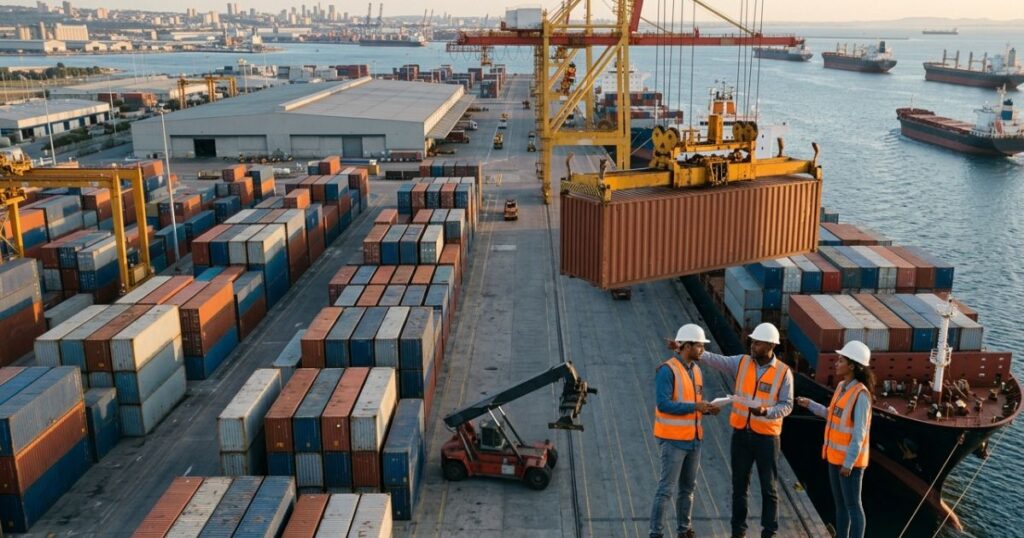
Coastal gateways are the physical anchors of globalization. They are the only facilities capable of handling the sheer volume and weight of international maritime trade.
In Pakistan, the southern coastline dictates the country’s economic pulse. Karachi Port handles a massive mix of bulk, break-bulk, and containerized cargo. Port Qasim specializes in heavy industrial goods, LNG, and coal. Gwadar Port represents the future of regional transit, anchoring the China-Pakistan Economic Corridor (CPEC).
These coastal mega-structures manage the massive post-Panamax vessels that drive global commerce. They provide the deep-water drafts required for heavy tonnage.
Without sea ports, international trade would be restricted to expensive air freight or limited cross-border trucking. They are the primary revenue generators for national customs and the ultimate gatekeepers of a nation’s economy.
Dry Port vs. Bonded Warehouse
People often confuse inland terminals with bonded warehouses. While they share similarities, their roles in the supply chain are distinct.
A bonded warehouse is a secure facility where dutiable goods are stored without paying duties until they are removed. They are heavily regulated by customs authorities. You use them to manage cash flow, holding inventory until you are ready to sell it locally or re-export it.
An inland terminal, however, is a complete logistics hub. It includes bonded warehouses, but it also features rail yards, container handling equipment, and direct transport links to the coast.
Think of a bonded warehouse as a secure storage room. The inland terminal is the entire transit facility built around that room.
Dry Port vs. Intermodal Terminal
Dry ports and intermodal terminals are both important parts of modern logistics systems, but they serve slightly different roles. A dry port is an inland facility connected to a seaport where customs clearance, cargo handling, and storage take place away from the coastal port. An intermodal terminal, on the other hand, is a transfer point where goods are moved between different transport modes like rail, road, or sometimes air—without necessarily handling customs processes.
What is a Dry Port?
A dry port functions as an extension of a seaport located inland. It allows importers and exporters to complete customs procedures, store goods, and manage container handling far from the busy coastal port. This helps reduce congestion at seaports and speeds up cargo movement. Dry ports are especially useful for landlocked areas or regions far from major shipping ports, providing businesses with easier access to international trade routes.
What is an Intermodal Terminal?
An intermodal terminal is a logistics hub where cargo is transferred between different transportation systems, such as trucks, trains, or ships. Unlike a dry port, it does not always handle customs clearance or full cargo processing. Its main role is to improve the efficiency of freight movement by enabling smooth transitions between transport modes, reducing delivery time, and lowering transportation costs.
Expert Insight: How to Choose the Right Port for Your Business
Selecting the optimal routing for your cargo requires strategic planning. A poor choice leads to delays, damaged goods, and ruined profit margins.
Follow this step-by-step approach to optimize your Pakistani logistics strategy:
Step 1: Analyze Your Cargo Profile
Are you moving perishable agricultural goods, heavy machinery, or fast-moving consumer goods (FMCG)? High-value, time-sensitive goods might need immediate coastal clearance and expedited trucking. Bulk commodities are better suited for rail transit to an inland facility.
Step 2: Map Your Final Destination
Look at the geographical spread of your distribution network. If your manufacturing plant is in Sialkot, routing your imports under bond to the Sambrial Dry Port makes far more sense than clearing them in Karachi.
Step 3: Evaluate Transport Costs vs. Storage Fees
Run the numbers on demurrage. Coastal storage fees stack up rapidly. Sometimes, paying a premium for immediate rail transport to a cheaper inland storage facility yields massive net savings.
Step 4: Check Infrastructure and Equipment Limits
Not all inland facilities are created equal. Verify that your target terminal has the necessary reach stackers, reefer (refrigerated) plug-in points, or specialized handling equipment for your specific cargo.
Step 5: Assess Customs Efficiency
Speak with your clearing agents. Certain terminals have reputations for faster, digitized customs processing. Leverage the facilities utilizing the latest electronic data interchange (EDI) systems like WeBOC (Web Based One Customs).
Conclusion
In simple terms, a sea port is the main gateway for international shipping, while a dry port acts as a supportive inland hub that improves logistics efficiency. Both work together to speed up trade, reduce delays, and make cargo movement more organized and cost-effective.
FAQs
What is the main function of a dry port in Pakistan?
Its primary function is to bring sea port services closer to inland merchants. It allows importers and exporters to handle customs clearance, container storage, and cargo consolidation in cities like Lahore, Faisalabad, and Multan, bypassing congestion in Karachi.
Can ships arrive at a dry port?
No. These facilities are strictly landlocked. They rely on intermodal transport—specifically heavy rail networks and highway trucking routes—to receive shipping containers that were originally unloaded from vessels at coastal gateways.
Why is Gwadar Port important for Pakistan’s logistics?
Gwadar is a deep-sea port designed to handle massive cargo vessels. It provides a strategic alternative to the heavily congested Karachi ports and serves as the primary maritime anchor for CPEC, connecting western China directly to the Arabian Sea.
How does cargo move from Karachi to an inland terminal?
Cargo primarily moves via the Pakistan Railways freight network or on heavy goods vehicles (HGVs) via the National Highway network (N-5) and motorways. Goods are typically transported “under bond,” meaning customs duties are paid upon arrival at the inland destination.