
Shipping calculations can feel confusing, especially when you’re dealing with volume and weight charges together. If you’re looking for an easy way to calculate cbm and freight ton, this guide will simplify everything for you. Whether you’re handling sea freight, air cargo, or local shipments, understanding these two terms helps you avoid overpaying and plan smarter. Let’s break down the formulas and concepts in the simplest, most practical way possible.
Mastering CBM and Freight Ton: A Comprehensive Guide
Ever tried to mail a giant teddy bear to your cousin? You probably realized pretty quickly that the cost wasn’t just about how heavy it was. The sheer size of the box likely made the shipping price jump. Welcome to the world of shipping, where size and weight are in a constant dance to decide how much you pay. If you’ve ever felt puzzled by shipping quotes, you’re in the right place.
This guide is your new best friend for understanding two of the most important ideas in shipping: CBM and Freight Ton. We’re going to break it all down, piece by piece, so you can ship anything from a tiny box to a house-full of furniture without breaking a sweat (or the bank). Let’s dive in and make shipping simple.
Foundations of CBM and Freight Ton
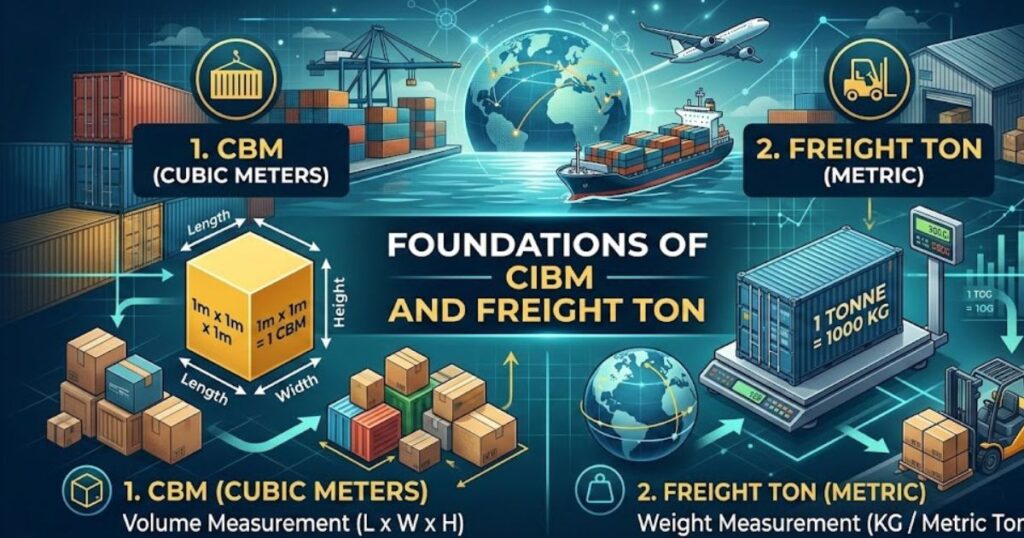
What is CBM and How is it Calculated?
Let’s start with CBM. It sounds like a secret code, but it just stands for Cubic Meter. Think of it as a way to measure how much space your package takes up. Imagine a cube that’s 1 meter long, 1 meter wide, and 1 meter tall. That’s one cubic meter.
Shipping companies, especially for sea freight, care a lot about space. A ship can only hold so much stuff, so they need to know the volume of every package. Calculating CBM is super easy. All you need is a tape measure and this simple formula:
Length (in meters) x Width (in meters) x Height (in meters) = Your CBM
For example, if you have a box that is 2 meters long, 1 meter wide, and 0.5 meters high, the calculation is:
2 x 1 x 0.5 = 1 CBM
Just like that, you’ve figured out your package’s volume! It’s that simple. Remember to measure everything in meters. If you measure in centimeters, just divide each number by 100 to convert it to meters before you multiply.
Freight Ton Explained: When Weight Matters More Than Volume
Now, let’s talk about Freight Ton. This is where things get interesting. Sometimes, you might ship something that’s small but incredibly heavy, like a box of gold bars (we can dream, right?). In this case, the shipping company is more concerned with the weight than the space it takes up.
A freight ton is a unit of weight, usually equal to 1,000 kilograms (or 1 metric ton). Shipping companies will look at both your CBM (volume) and your freight ton (weight). They will then charge you based on whichever number is higher. This is often called “chargeable weight.”
Think of it like this: if your package of fluffy pillows has a CBM of 2 but only weighs 100 kg (0.1 freight tons), the shipping company will charge you for 2 CBM because the pillows take up a lot of space. But if your small box of lead weights has a CBM of 0.5 but weighs 1,500 kg (1.5 freight tons), you’ll be charged for 1.5 freight tons because the weight is the bigger factor. It’s the carrier’s way of making sure they get paid fairly for either the space you use or the weight they have to carry.
The Science Behind Volumetric Weight and Its Role in Freight Billing
You’ll also hear the term Volumetric Weight or Dimensional Weight. This is a clever way for shipping companies, especially in air freight, to convert the size of your package into a “pretend” weight. Airplanes have even stricter limits on both space and weight than ships do.
Here’s how it works: they take the dimensions of your package and use a special formula to figure out its volumetric weight. A common formula for air freight is:
(Length in cm x Width in cm x Height in cm) / 6000 = Volumetric Weight in kg
Let’s say you’re shipping a large box of popcorn that is 100 cm x 50 cm x 50 cm.
(100 x 50 x 50) / 6000 = 41.67 kg.
Even if the actual weight of the popcorn is only 5 kg, the airline will see it as 41.67 kg for billing purposes. They will compare this volumetric weight to the actual weight and, you guessed it, charge you for the higher number. This ensures they don’t lose money shipping big, light items that hog precious cargo space. Understanding both CBM and Freight Ton is the first step to mastering your shipping costs.
Step-by-Step Guides
How to Calculate CBM for Standard and Irregular Cargo
Calculating CBM for a standard square or rectangular box is a piece of cake. But what about that oddly shaped floor lamp or a giant, lumpy beanbag chair? Don’t worry, the process is just as simple.
For any irregular-shaped item, the trick is to imagine it inside a perfect, snug-fitting rectangular box.
- Find the Longest Point: Measure the item at its absolute longest part. This is your length.
- Find the Widest Point: Measure the item at its widest part. This is your width.
- Find the Tallest Point: Measure the item at its tallest part. This is your height.
Once you have these three measurements (in meters), you use the same old CBM formula: Length x Width x Height. This method ensures you account for the maximum space the item will occupy, even if it has curves and bumps. Shipping companies use this “extreme dimensions” method, so you should too, to avoid any surprise charges.
For cylindrical items like pipes or rolls of fabric, the formula changes slightly:
π (pi, which is about 3.14) x radius² (in meters) x height (in meters) = CBM
The radius is half of the diameter (the width across the circular face). But honestly, most people just use the “invisible box” method for everything because it’s easier and universally accepted.
A Beginner’s Guide to Freight Ton Calculation
Calculating the freight ton is even simpler than CBM. You just need to know the weight of your shipment.
- Weigh Your Cargo: Get the total weight of your items in kilograms. A bathroom scale works for small items, but for larger shipments, you’ll need an industrial scale.
- Convert to Tons: Divide the total kilograms by 1,000.
That’s it! For example, if your shipment weighs 2,500 kilograms:
2,500 / 1,000 = 2.5 Freight Tons
Now you have both the CBM and the freight ton for your shipment. The shipping company will quote you a price “per W/M” (weight or measure), meaning they’ll charge based on whichever is greater. You can now predict exactly what your chargeable weight will be.
How to Choose Between Air, Sea, and Road Freight Based on CBM
Now that you’re a pro at calculating CBM, how does it help you choose a shipping method?
- Sea Freight: This is your best bet for large, heavy shipments where time isn’t a huge issue. If your CBM is high, sea freight is almost always the most cost-effective option. It’s perfect for moving furniture, cars, or large quantities of goods.
- Air Freight: Choose air freight for smaller, lighter shipments that need to arrive quickly. Because space on a plane is so limited and expensive, air freight is not ideal for high-CBM items unless speed is your absolute top priority. If your volumetric weight is much higher than your actual weight, be prepared for a hefty bill.
- Road Freight: For domestic shipping, trucks are the way to go. CBM and weight are still important, as a truck can only hold so much. Road freight offers a good balance of cost and speed for shipments within a country or continent.
In short: Big CBM? Think sea. Small CBM and urgent? Fly it. Staying local? Hit the road.
Tools and Techniques
The Best CBM Calculators for Accurate Results
Doing math is fine, but why not let technology do the heavy lifting? There are tons of free online CBM calculators that make the process instant and error-free. These tools are fantastic because they:
- Handle Unit Conversions: You can enter dimensions in centimeters, inches, or feet, and the calculator will convert them to meters for you.
- Calculate Everything at Once: Most calculators will show you the CBM, volumetric weight, and even how many of your boxes might fit into a standard shipping container.
- Are Free and Easy: Websites like CBMcalculator.com or the tools offered by major logistics companies are simple to use and don’t cost a thing.
Using a calculator saves time and reduces the chance of making a costly math mistake. It’s a smart move for anyone who ships items regularly.
How to Use Technology to Optimize Freight Planning
Beyond simple calculators, technology offers powerful tools for freight planning. Logistics software can help you:
- Compare Carrier Rates: Instantly get quotes from multiple shipping companies to find the best deal.
- Track Shipments in Real-Time: Know exactly where your cargo is at any moment, giving you and your customer peace of mind.
- Optimize Routes: Software can find the most efficient route for your shipment, saving both time and money.
- Manage Documentation: Shipping involves a lot of paperwork. Technology can help you fill out and store customs forms and bills of lading digitally.
Embracing these tools can turn a logistical headache into a smooth, streamlined process.
Visualizing Cargo Space: The Benefits of 3D Load Planning
Have you ever played Tetris? 3D load planning is basically Tetris for your shipping container. These amazing tools let you create a virtual, 3D model of how your boxes and items will fit inside a container.
The benefits are huge:
- Maximize Space: A 3D planner shows you the most efficient way to stack and arrange your cargo, helping you fit more in and potentially avoid paying for a second container.
- Prevent Damage: You can plan to put heavy items on the bottom and fragile items on top, reducing the risk of things getting crushed.
- Create Loading Guides: The software can generate step-by-step instructions for the people who will physically load the container, ensuring your plan is followed perfectly.
Using a 3D load planner takes the guesswork out of container packing and helps you use every last inch of space you’re paying for.
Unique Insights and Tips
How to Calculate CBM for Fragile or Oversized Items
When dealing with fragile items, like a glass sculpture, you have to account for the packaging. Your CBM calculation should be based on the dimensions of the final, packaged crate, including all the protective padding. A good rule of thumb is to add at least 10-15 cm to each dimension for cushioning.
For oversized items that might not fit in a standard container, like a boat or industrial machinery, you’ll be dealing with “break-bulk” shipping or special containers like flat racks. The CBM calculation is the same (length x width x height), but the shipping rates will be much higher. It’s crucial to get precise measurements for these items, as even a small error can cost thousands.
The Hidden Costs of Incorrect CBM Calculations
Getting your CBM or weight wrong can lead to a cascade of expensive problems:
- Carrier Fines: If your declared CBM is lower than the actual CBM, the carrier will re-measure it and charge you the difference, often with a hefty penalty fee.
- Storage Fees: If your cargo doesn’t fit as planned, it might have to be left at the port while you arrange for another container, racking up daily storage charges.
- Customs Delays: Incorrect dimensions on your paperwork can raise red flags with customs officials, leading to inspections and delays that can hold up your shipment for weeks.
Taking an extra five minutes to double-check your measurements can save you a world of trouble and money.
How to Negotiate Freight Rates Using CBM Data
Knowledge is power, especially when negotiating with freight forwarders. When you can provide them with precise CBM and weight data, you show that you’re a serious and organized shipper.
You can leverage this data to:
- Ask for Better Rates: If you have a large, regular volume of shipments, you can negotiate a discount.
- Challenge Quotes: If a quote seems too high, you can ask for a breakdown and compare it to your own calculations.
- Plan for Consolidation: If you have several small shipments (LCL or Less than Container Load), you can ask your forwarder to consolidate them into one larger shipment to save money.
Coming to the table with accurate numbers gives you credibility and a much stronger negotiating position.
Localized Content for Pakistan
Freight Planning Challenges in Pakistan: What You Need to Know
Shipping in and out of Pakistan comes with its own unique set of opportunities and challenges. Port congestion, particularly at Karachi Port, can sometimes lead to delays. The road infrastructure, while improving, can be unpredictable, especially in remote areas. It’s also vital to be well-versed in the local customs regulations, which can be complex. Working with a reliable, local freight forwarder who understands these nuances is key to a smooth shipping experience.
How to Calculate CBM for Popular Pakistani Export Goods
Pakistan exports a wonderful variety of goods, from textiles and leather products to sports equipment and surgical instruments. Let’s consider textiles. A large bale of cotton might be light for its size, making it a high-CBM shipment. Its volumetric weight will likely be much higher than its actual weight.
On the other hand, a shipment of surgical instruments would be dense and heavy. For these items, the freight ton (actual weight) will almost certainly be the basis for the shipping cost. Understanding the relationship between CBM and Freight Ton is crucial for Pakistani exporters to price their products competitively on the global market.
Local Freight Services and Tools for Accurate CBM Calculation
Many logistics companies in Pakistan, like Speedaf Logistics PK, offer free online CBM calculators tailored for local businesses. These services often provide door-to-door solutions, handling everything from pickup and customs clearance to final delivery. Using a local expert who understands the specific dynamics of shipping in Pakistan can make the entire process of calculating CBM and Freight Ton and managing your logistics far more efficient.
Reader Questions and Expert Advice
Question: How Do I Calculate CBM for Multiple Items in a Single Shipment?
This is a great question! You have two simple options:
- If the boxes are all the same size: Calculate the CBM for one box, then multiply that by the total number of boxes.
- If the boxes are different sizes: Calculate the CBM for each box individually, then add all the CBMs together to get your total shipment volume.
An online CBM calculator with a “multiple products” feature can make this process incredibly fast.
Question: What Are the Most Common Errors in CBM Calculation?
The biggest mistakes are surprisingly simple ones:
- Mixing Up Units: Using a mix of centimeters and inches, or forgetting to convert to meters before multiplying. Always stick to one unit!
- Forgetting Packaging: Measuring the item itself instead of the final, packaged box. The outer dimensions are what matter.
- Guessing: Eyeballing the measurements instead of using a tape measure. A few centimeters here and there can add up to a significant and costly error.
Expert Tips for Reducing Freight Costs Without Compromising Efficiency
- Pack Smart: Use standardized box sizes whenever possible and pack them tightly to eliminate wasted space.
- Plan Ahead: Last-minute shipments are always more expensive. Give yourself plenty of time to find the best rates.
- Consolidate Shipments: Instead of sending five small packages, see if you can combine them into one larger, more cost-effective shipment.
Beyond the Basics
How to Plan Shipments for Maximum Container Utilization
Achieving high container utilization is the gold standard of efficient shipping. Use a 3D load planner to design your layout. Mix and match box sizes to fill gaps. Think vertically and stack items securely, always keeping weight distribution in mind. A well-packed container not only saves money but also protects your goods during transit.
The Role of CBM in Sustainable Shipping Practices
Sustainability is becoming a huge focus in logistics. By packing containers more efficiently, we can reduce the total number of shipments needed. This means fewer ships on the ocean and fewer trucks on the road, leading to a significant reduction in carbon emissions. Accurate CBM calculation is the first step toward greener, more responsible shipping.
Future Trends in Freight Planning and CBM Technology
The future is exciting! We’re seeing the rise of “smart containers” equipped with sensors that track location, temperature, and even whether the container has been opened. Artificial intelligence is also beginning to play a role in optimizing shipping routes and predicting costs with incredible accuracy. These technologies will make understanding CBM and Freight Ton even more dynamic and integrated into a fully transparent supply chain.
Conclusion
You’ve made it! From CBM to 3D load planning, you now have the knowledge to tackle the world of shipping with confidence. Understanding how CBM and Freight Ton work together is the key to unlocking smarter, more cost-effective shipping strategies. You no longer have to feel lost in a sea of confusing quotes and technical terms.
So go ahead, measure your packages, use the tools available to you, and start planning your shipments like a pro. Your wallet—and your customers—will thank you for it. Happy shipping