
Warehouse fulfillment is the process of storing, picking, packing, and shipping products to customers on behalf of a business. It is a key part of the supply chain used by eCommerce companies and retailers to ensure fast and accurate order delivery. Fulfillment centers manage inventory, process orders, and handle shipping logistics efficiently, helping businesses save time and reduce operational costs.
Understanding Warehouse Fulfillment
If you want to scale your business, packing boxes in your living room stops working the moment you hit a real growth spike. That is where warehouse fulfillment steps in to save your sanity.
A traditional warehouse just stores things. It is static. A fulfillment center is beautifully, chaotically alive.
It is a specialized hub designed for speed. Products arrive from your manufacturer, get logged into a digital system, and are placed strategically on shelves. The moment a customer places an order, the system lights up. A worker (or a robot) grabs the item, packs it safely, prints a shipping label, and hands it to a delivery driver.
In markets like Pakistan, where Cash on Delivery (COD) rules the game, this process is even more vital. If a package dispatched from a Karachi hub takes too long to reach Lahore, the buyer might change their mind and refuse the delivery. Speed is not just a luxury. It is how you protect your profit margins.
How Does Warehouse Fulfillment Work?
If you want to know what warehouse fulfillment is in practice, you have to look at the assembly line. Every great e-commerce fulfillment operation follows five non-negotiable steps.
Receiving Inventory
You cannot sell what you cannot find. When your products arrive from a supplier, the warehouse team unloads them, counts them, and inspects for damage. Every single item gets scanned into a Warehouse Management System (WMS). If this step is sloppy, your inventory numbers will be wrong, and you will end up selling out-of-stock items.
Storage and Organization
Items do not just get tossed onto random shelves. Inventory management is a science. Fast-moving products like a trending phone case are stored close to the packing stations. Slower-moving bulk items get stored higher up or further back. This intelligent layout cuts down on the time it takes to grab an item.
Picking and Packing
Your customer clicks “buy.” The WMS instantly generates a pick list. A warehouse associate navigates the aisles, grabs the exact item, and brings it to the packing station. Here, picking and packing services take over. The team chooses the right box size to avoid extra shipping weight, adds bubble wrap, and seals the deal.
Shipping Logistics
Once the box is sealed, it gets a tracking label. The fulfillment provider usually has negotiated rates with major couriers. The package is sorted and handed over to the courier network. Whether it is moving via overnight air freight or a local delivery van, the goal is getting it to the door fast.
Returns Management (Reverse Logistics)
Returns happen. When a customer sends a product back, the warehouse receives it, inspects it for damage, and decides if it can go back on the shelf. In Pakistan, where failed COD deliveries trigger automatic returns, a smooth returns management system is the only way to avoid bleeding cash.
Warehouse Fulfillment vs. Fulfillment Center
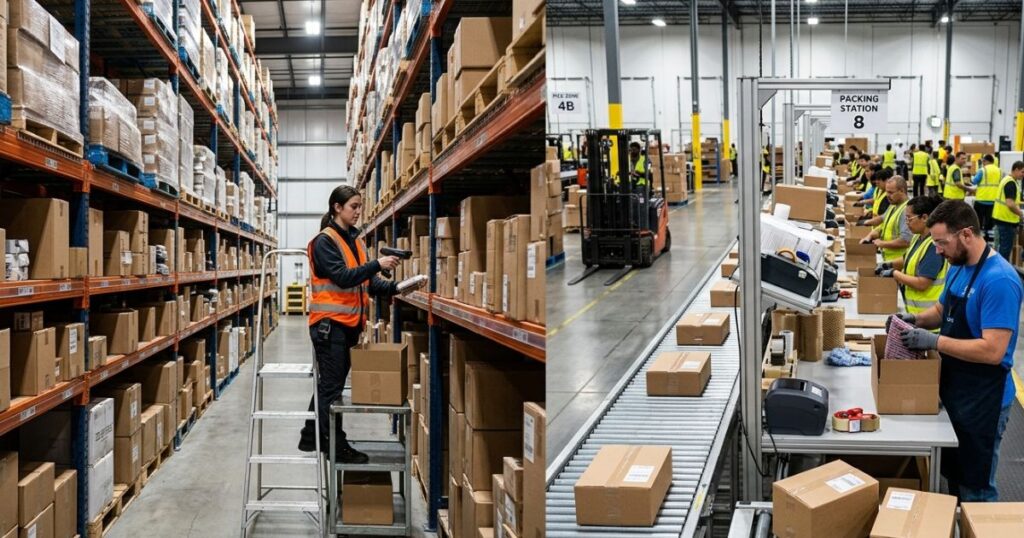
Are these two terms the same thing? Mostly, yes. But there is a slight operational difference you should know when negotiating with a third-party logistics (3PL) provider.
Warehouse Fulfillment generally refers to the process itself. It is the act of storing and moving goods out the door. You can do this in-house, in your own leased space.
A Fulfillment Center is the actual facility operated by a 3PL partner. These massive hubs are built purely for rapid consumer delivery. They integrate directly with platforms like Shopify or WooCommerce.
| Feature | Standard Warehouse | Fulfillment Center |
| Primary Goal | Long-term bulk storage | Rapid, individual order shipping |
| Pace of Movement | Slow and static | Fast and dynamic |
| Customer Focus | B2B (Business to Business) | B2C (Direct to Consumer) |
| Technology | Basic spreadsheets | Advanced WMS and live tracking |
Benefits of Warehouse Fulfillment for E-Commerce Businesses
Why should you care about upgrading your logistics? Because bad shipping kills good brands. Here is what happens when you get your fulfillment right.
- You save serious money. By outsourcing to a 3PL, you stop paying for empty warehouse space and full-time packing staff during slow months. You only pay for what you use.
- Your customers stay loyal. Fast, accurate delivery builds trust. When buyers know you deliver on time, they come back.
- You unlock nationwide reach. Storing your products in major hubs like Karachi, Lahore, and Islamabad means you can offer next-day delivery to a massive chunk of the country.
- You get your time back. You are a business owner, not a professional box-taper. Letting experts handle logistics frees you up to focus on marketing and product development.
Expert Insights: How to Optimize Your Fulfillment Process
As someone who watches supply chains break and rebuild every day, I can tell you that successful brands do not just guess. They engineer their workflows. Here is how you can optimize your operation and avoid the common traps.
Mistake #1: Flying blind with inventory.
Do not rely on manual counts. Implement a smart Warehouse Management System (WMS). You need real-time data showing exactly what is on the shelf. If you oversell a product you do not actually have, you lose the sale and the customer forever.
Mistake #2: Ignoring the COD cash cycle.
In the Pakistani market, your fulfillment partner is also your bank. If a 3PL holds onto your cash on delivery payments for three weeks, your cash flow dies. Choose a partner that remits your funds twice a week.
Mistake #3: Poor packaging choices.
Using a giant box for a tiny item does not just look ridiculous to the buyer. It costs you money. Shipping carriers charge by “dimensional weight.” Optimize your packaging sizes to match your products exactly. It shaves a massive percentage off your monthly shipping bill.
Content Gap: The Role of Climate-Controlled Storage
Many brands forget to ask about the temperature of the building holding their goods. Climate-controlled storage is not a luxury; for many industries, it is a legal and practical requirement.
If you sell cosmetics, skincare, chocolates, or electronics, a standard warehouse in the middle of July will destroy your inventory. A warehouse hitting 40°C will melt your lipsticks and ruin your gadgets before they ever see a shipping label.
Climate-controlled facilities maintain specific temperature and humidity levels year-round. They cost a little more per cubic foot, but they prevent thousands of dollars in ruined stock and brutal customer reviews.
Content Gap The Impact of Automation on Fulfillment Efficiency
We are moving away from the era of men with clipboards. Advanced automation in warehouses is changing how fast we get our online orders.
Think about conveyor belts that automatically sort packages by postal code. Think about wearable barcode scanners that tell a worker exactly which aisle to walk down. Some elite centers are even deploying robotic carts that bring the shelving unit directly to the packer, entirely eliminating the time humans spend walking.
What does this mean for you? Near-perfect order accuracy. When machines guide the picking process, the chance of a customer getting the wrong item drops to almost zero. When you evaluate a 3PL, ask them about their tech stack. A facility running on automated barcoding will always outperform a facility running on pen and paper.
Conclusion
Warehouse fulfillment plays a vital role in modern eCommerce and retail operations. It improves order accuracy, speeds up delivery, and allows businesses to focus on growth instead of logistics. By using professional fulfillment services, companies can enhance customer satisfaction and scale their operations more effectively.
FAQs
What is the purpose of warehouse fulfillment?
The purpose of warehouse fulfillment is to securely store inventory and rapidly process customer orders. It ensures that products are picked, packed, and shipped accurately the moment a purchase is made online.
How is warehouse fulfillment different from warehousing?
Warehousing is simply storing bulk goods for a long period. Warehouse fulfillment is an active process focused on picking individual items, packing them into parcels, and shipping them directly to consumers.
Why is warehouse fulfillment important for e-commerce?
It dictates the customer experience. If fulfillment is slow or inaccurate, customers will leave bad reviews and never return. Fast fulfillment drives brand loyalty and reduces costly returns.
What are the costs of warehouse fulfillment services?
Costs typically include a receiving fee, a monthly storage fee based on the space you use, a pick-and-pack fee per order, and the actual shipping courier costs.
How do I choose the right fulfillment provider?
Look for a provider with facilities close to your biggest customer bases. Check their order accuracy rates, ensure their software integrates directly with your website, and confirm their return-handling procedures.