
The China Import and Export Fair, commonly known as the Canton Fair, is one of the world’s largest trade exhibitions. In 2026, it continues to play a major role in global commerce by connecting buyers and suppliers from hundreds of industries. From electronics and machinery to textiles and consumer goods, the fair offers endless sourcing opportunities. For businesses, it’s not just an event it’s a strategic gateway to international trade, networking, and market expansion.
What the China Import and Export Fair Actually Is (And Why the Scale Matters)
The China Import and Export Fair refers to the biannual trade exhibition held at the China Import and Export Fair Complex in Pazhou, Guangzhou. It’s co-hosted by China’s Ministry of Commerce and the Guangdong provincial government, and organized by the China Foreign Trade Centre (CFTC).
The fair leans toward exports meaning Chinese manufacturers come to sell to the world though an International Pavilion now brings foreign sellers into the mix too.
According to China Daily (November 2025), the 138th Canton Fair drew a record 310,000 overseas buyers from 223 countries and regions, generating $25.65 billion in intended export transactions a 7.5% increase from the previous session. The 138th fair also welcomed 550 buyer delegations and 158 business organisations attending as groups. This isn’t a niche sourcing event you attend on a whim. It requires preparation.
The fair is open to any registered overseas buyer. You don’t need a business license from a specific country, and there’s no product category restriction on who can attend.
2026 Canton Fair Dates, Phases, and Product Categories
The 139th Canton Fair (Spring 2026) runs in three non-overlapping phases. Each phase covers distinct product categories attending the wrong phase for your sourcing goals means you’ll walk 10km of exhibition halls and find nothing relevant.
Phase 1 April 15–19, 2026 Electronics & Appliances, Manufacturing Equipment, Vehicles & Two Wheels, Lighting & Electrical, Hardware, International Pavilion
Phase 2 April 23–27, 2026 Houseware, Gifts & Decorations, Building Materials, Furniture, International Pavilion
Phase 3 May 1–5, 2026 Toys, Children’s & Maternity Products, Fashion & Apparel, Home Textiles, Stationery, Health & Recreation, Traditional Chinese Specialties, International Pavilion
There’s a gap of 3–4 days between each phase. If you’re sourcing across multiple categories say, electronics AND textiles you’ll need to plan for an extended trip or choose one phase to prioritise.
Quick Comparison: Which Canton Fair Phase Should You Attend?
| Phase | Best For | Key Benefit | Limitation |
| Phase 1 | Electronics, hardware, industrial buyers | Widest manufacturer range, highest exhibitor density | Most crowded; book hotels months in advance |
| Phase 2 | Retailers, gift importers, interior trade | Strong for private label home & gifting products | Smaller international pavilion presence |
| Phase 3 | Fashion, toy, textile sourcing | Apparel MOQs tend to be more negotiable | Fewer heavy industrial contacts |
How to Register for the Canton Fair as a Foreign Buyer
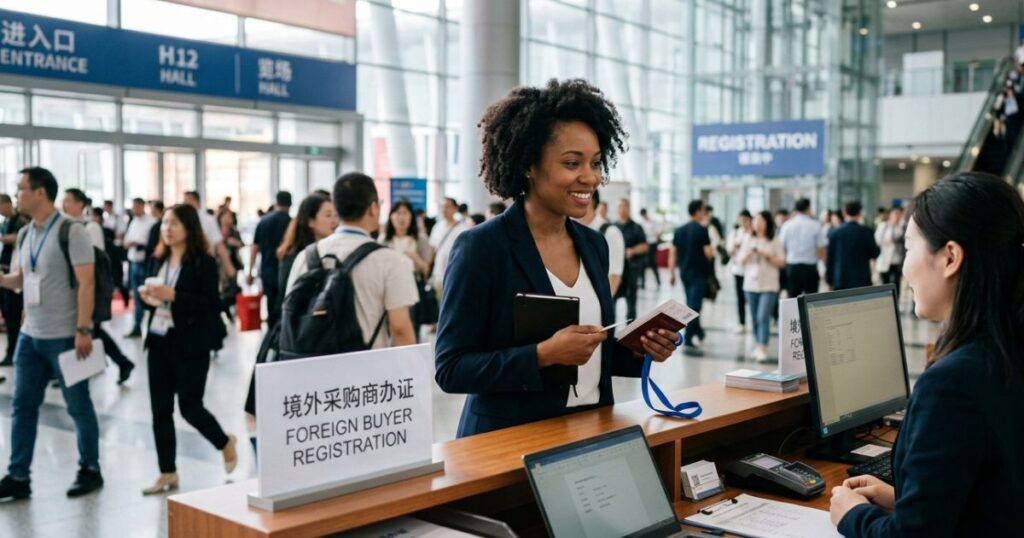
This is the step most guides summarise in two vague sentences. Don’t skip this section.
To register for the Canton Fair as an overseas buyer, follow these steps
- Go to cantonfair.org.cn and create a buyer account under “Overseas Buyer”
- Complete pre-registration using the Buyer E-service Tool (BEST) — it’s free
- Apply for your visitor badge through the BEST platform once registration opens
- Request an official invitation letter from the system if your country requires a China visa
- Submit your visa application at the Chinese embassy using the invitation letter as supporting documentation
Each step takes 10–30 minutes. The invitation letter is system-generated; you don’t need to email anyone. QR code credentials now reduce on-site registration to under 30 seconds once you arrive.
Look if you’re applying from Pakistan the visa step is the one that kills timelines. Apply at least 8 weeks before Phase 1 opens. Chinese embassies in some markets have limited appointment slots during peak trade fair season.
Getting the badge is the easy part. Getting the visa in time is where most first-timers underestimate the lead time required.
Sourcing Strategy How to Spend Your Time at the Fair
Walking in without a plan is expensive. Not in entry fees those are minimal but in time, missed connections, and bad supplier choices made under pressure.
The exhibitor list goes live on the official platform months before the fair opens. Use it. Search by product category, filter by export experience, and shortlist 20–30 booths before you land in Guangzhou. The official platform is 365.cantonfair.org.cn it runs year-round, not just during fair season.
Some experts argue that attending without pre-arranged meetings is fine because the fair is designed for walk-in discovery. That’s valid for buyers who’ve been before and know the layout. But if you’re in your first or second cycle, structured pre-visit outreach cuts your sourcing time by roughly half.
Most suppliers at the fair have high minimum order quantities (MOQ). That’s a real constraint. If you’re a small importer testing a product line, the Canton Fair will show you the landscape but you may need to negotiate MOQs post-fair via email, or consider the Yiwu Market as a parallel sourcing option for lower-volume orders.
I’ve seen conflicting data on this some sourcing consultants say MOQs at the fair are fixed and non-negotiable on the floor, others say factory reps have more flexibility in-person than online. My read is that it depends entirely on the exhibitor type: trading companies tend to be more flexible than direct factories.
One counter-intuitive insight: the International Pavilion, which most buyers ignore in favour of Chinese manufacturer booths, is worth one dedicated half-day. Foreign exhibitors from Southeast Asia, the Middle East, and Africa are actively using the Canton Fair to enter the Chinese import market which means there are bilateral trade opportunities there that pure sourcing-focused buyers miss entirely.
Practical Logistics: Getting There, Staying Near, Getting Around
The fair venue is the China Import and Export Fair Complex, located at Yuejiang Zhong Road, Guangzhou 510335 accessible via Guangzhou Metro Line 8 (Pazhou Station) and widely served by taxis.
Book accommodation early. Hotel rooms within walking distance of the Pazhou complex sell out 2–3 months before Phase 1 opens. Mid-range options start around $97–140/night for fair-adjacent properties; budget alternatives require a metro commute.
Bullet train connections from Hong Kong’s West Kowloon station to Guangzhou South take under 50 minutes. Many international buyers route through Hong Kong. It’s worth knowing if your regional carrier doesn’t fly direct to Guangzhou Baiyun International Airport.
Bring business cards. Bring more than you think you need. Bring a charger. The halls are massive and signal drops are common on the show floor.
Currency at the fair is primarily Chinese Yuan (RMB), though many international exhibitors accept USD and EUR. Some will quote in USD on the floor but the invoice in RMB clarifies this before agreeing to anything.
Conclusion
The China Import Export Fair remains a powerful platform for global trade in 2026. Success at the fair depends on preparation, clear sourcing goals, and strong supplier evaluation. Whether you’re a first-time visitor or a seasoned importer, leveraging this event can open doors to profitable partnerships and long-term business growth.
FAQs
What is the China Import and Export Fair?
It’s a biannual trade fair held in Guangzhou, China, since 1957. Known as the Canton Fair, it’s the world’s largest, hosting 32,000+ exhibitors and over 300,000 international buyers per session.
How do I register for the Canton Fair as a foreign buyer?
Register free on cantonfair.org.cn using the Buyer E-service Tool (BEST). Complete pre-registration, apply for your badge, and request an invitation letter for your visa application.
When is the Canton Fair in 2026?
Spring 2026 runs in three phases: Phase 1 (April 15–19), Phase 2 (April 23–27), and Phase 3 (May 1–5), all at the Pazhou Complex in Guangzhou.
Should I attend one phase or all three of the Canton Fair?
Attend the phase matching your product category. Most buyers only need one phase. If you source across categories like electronics and textiles, plan for two separate trips or an extended stay.
Why does the Canton Fair matter for international sourcing?
According to China Daily, the 138th fair generated $25.65 billion in intended export transactions. It’s the single most direct route to verified Chinese manufacturers, with no middlemen and face-to-face price negotiation.