
Sea Freight China to Pakistan is the most cost-effective and reliable shipping solution for businesses and importers who need safe cargo delivery at competitive rates. Whether you are shipping small consignments or full containers, sea freight offers secure transport, flexible options, and affordable pricing. With professional logistics support, customs clearance, and timely delivery, shipping from China to Pakistan becomes simple, fast, and hassle-free for all types of goods.
What a Freight Forwarder Actually Does on the China Pakistan Route
Definition Block
A freight forwarder China to Pakistan is a logistics intermediary that coordinates the entire movement of goods from factory pickup in China through export customs, ocean or air transit, Pakistani customs clearance, and final delivery to your warehouse or shop. They don’t own the ships or planes; they negotiate rates with carriers and manage your paperwork.
That last part of paperwork is where most Pakistan-bound shipments either sail through or get stuck for weeks.
A good forwarder handles: commercial invoice preparation, HS code classification, bill of lading or air waybill, Pakistan Customs’ WeBOC filing, and any product-specific certificates (like a China Inspection and Quarantine Certificate for regulated goods). A bad one hands you a half-complete document set and bills you for the delay that follows.
Air Freight vs Sea Freight vs. Land Freight: Which Makes Sense for You
This is the decision most importers agonize over. Here’s the honest breakdown.
Quick Comparison
| Option | Best For | Key Benefit | Limitation |
| Air Freight | Urgent, high-value, <1,000 kg | 3–7 days transit | $4–$12/kg — expensive at scale |
| Sea Freight LCL | Small-medium loads, cost-sensitive | Cheapest per CBM for partial loads | 20–40 days, port congestion risk |
| Sea Freight FCL | Bulk importers, regular shipments | Best unit economics at volume | Minimum container commitment |
| Express (DHL/FedEx) | Samples, <70 kg parcels | Door-to-door, fastest | $5–$10/kg, not viable for commercial loads |
| Land via Khunjerab | Northern Pakistan importers | No port congestion | Seasonal closures, limited carrier options |
Sea freight to Karachi from major Chinese ports (Shanghai, Ningbo, Guangzhou) runs approximately 20–35 days depending on routing. Air freight from Beijing, Shanghai, or Shenzhen to Karachi or Lahore typically arrives in 3–7 days.
Air freight is better suited for electronics, medical equipment, and urgent restocks because speed justifies the cost premium. Sea freight LCL works better when your shipment exceeds 2 CBM and delivery timing is flexible. The key difference is not just price it’s cash flow and customs risk exposure.
Karachi port congestion is real and unpredictable. Importers who’ve shipped FCL in late Q3 and Q4 consistently report 5–12 day delays beyond quoted transit times. If you’re running a tight inventory cycle, that buffer needs to be in your plan.
The Real Cost of Shipping from China to Pakistan (With Numbers)
Most forwarder websites say “contact us for rates.” That tells you nothing. So here are current market benchmarks.
Total door-to-door LCL including origin charges, ocean freight, and destination handling typically lands CBM depending on season and cargo type.
Depending on port pair and season. September–November rates trend higher as Q4 demand builds.
All-inclusive pricing that bundles freight, customs clearance, duties, and last-mile delivery. Platforms like Sino Shipping and services like DocShipper offer DDP quotation tools that make comparing total landed cost much easier than piecing together individual line items.
Prices from comparison platforms like Freightos can vary by up to 20% between providers for the same lane worth running a quick quote before committing.
Pakistan Customs Duty Every Layer Explained
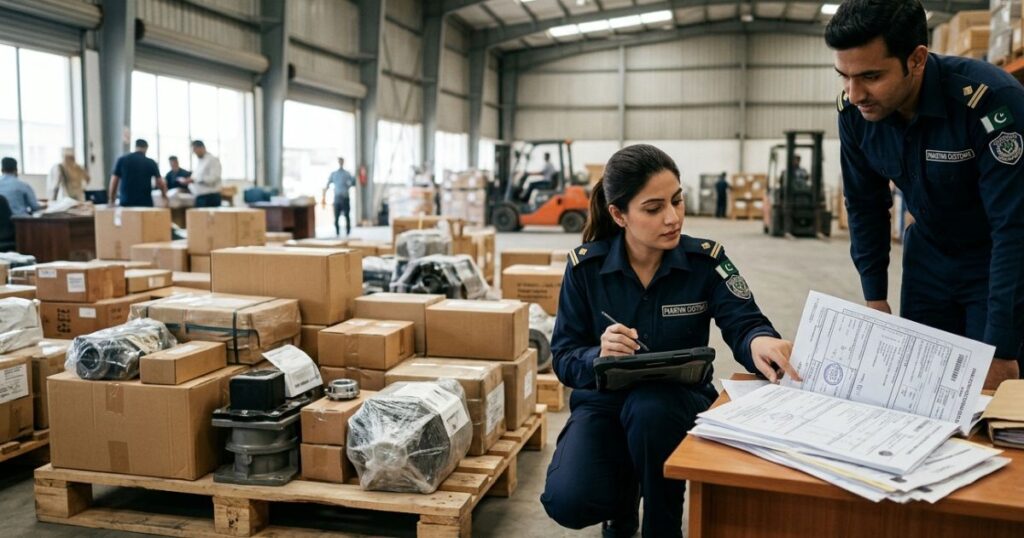
This is the section most guides skip entirely. It’s also where Pakistani importers get the most expensive surprises.
According to China’s General Administration of Customs, China exported $20.23 billion worth of goods to Pakistan in 2024 a 17% increase year-on-year — making China Pakistan’s largest single source of imports by a significant margin. That volume means Pakistani customs authorities are processing enormous cargo quantities, and enforcement has tightened, particularly around valuation and HS code accuracy.
Here’s every charge you may face when goods clear Pakistani customs
- Customs Duty: 0% to 25% ad valorem, depending on product category. Raw materials and capital goods attract lower rates; finished consumer goods often land in the 20–25% band. Check your product’s rate at the Pakistan Customs tariff portal (pacustoms.gov.pk) using your HS code before you ship anything.
- Sales Tax (GST): A flat 17% applied on the customs value plus customs duty. Non-negotiable. It applies to most goods.
- Regulatory Duty: 2% to 50%, applied to specific product categories the government wants to protect domestically. Electronics, textiles, and auto parts are common targets. This is the charge that blindsides first-time importers most often.
- Additional Customs Duty: An extra levy on select items. Ranges vary and change with annual budgets.
- Income Tax (Withholding Tax on Imports): Collected at import stage. Rate depends on filer status; active NTN filers pay less.
Your “customs duty” is never just one number. It’s five stacked charges, and the final landed cost can be 40–70% above your FOB invoice value once all layers are applied to higher-duty categories. Run this calculation before negotiating supplier prices.
DDP vs. FOB Which Incoterm Should You Use for Pakistan Imports?
This question comes up constantly in Pakistani importer communities and the confusion is understandable.
Your supplier delivers goods to the Chinese port. You control everything from there hiring the forwarder, paying freight, handling Pakistani customs. More visibility, more responsibility.
The forwarder or supplier manages everything from factory to your door, including Pakistani import duties. One invoice. No port surprises.
The supplier chooses the carrier to a named Pakistani port. You take over from there. This sounds convenient but often hides higher ocean freight markups and leaves you exposed to port handling charges you didn’t budget for.
For SMEs and first-time importers on the China–Pakistan route, the practical recommendation is FOB combined with a Pakistan-experienced freight forwarder managing the shipment end-to-end. You get cost transparency on freight without the compliance risk of CIF’s hidden charges. DDP is worth the premium if you’re importing regulated goods or don’t want to deal with customs paperwork at all.
Some logistics consultants argue DDP always costs more than FOB + separate customs clearance. That’s valid for experienced importers with a trusted local clearing agent already in place. But if you’re still building that relationship, the predictability of DDP often saves more than it costs.
How to Choose a Freight Forwarder for China–Pakistan Shipments
To select a reliable freight forwarder from China to Pakistan, follow these steps:
- Confirm they have active China-side agents — not just Pakistan-based operations.
- Ask for an all-in quote: freight + origin charges + destination handling + customs clearance fee.
- Verify they know your product’s HS code and can state the applicable duty rate.
- Check if they offer real-time shipment tracking, not just weekly email updates.
- Ask specifically about their Karachi port contacts and average clearance times.
Beyond the checklist, there are a few things most guides skip.
First: a forwarder with in-house customs clearance saves you a coordination layer. Costa Logistics, for example, operates as both a freight forwarder and a customs clearance company in Pakistan meaning you’re dealing with one entity from origin to delivery rather than separately managing a freight agent in China and a customs broker in Karachi.
Second: ask about their WeBOC filing experience. Pakistan’s WeBOC (Web-Based One Customs) system is the gateway for all import declarations. Errors in this filing cause holds. A forwarder who files it regularly on your product category will clear faster than one treating it as a one-off.
Third and this matters for buyers sourcing from Yiwu, Guangzhou, or Shenzhen specifically asking whether their China-side agent does consolidated cargo (LCL groupage). If they don’t, your small shipment may sit in a Chinese warehouse longer than quoted while waiting for a vessel booking.
The CPEC Land Route What Northern Pakistan Importers Should Know
Most freight guides ignore this entirely.
The Karakoram Highway (KKH) through the Khunjerab Pass connects Xinjiang, China to Gilgit-Baltistan and then southward into KPK and Punjab. Since December 2024, Khunjerab has been officially open year-round removing the previous winter closure that made it unreliable for commercial use.
For importers in Peshawar, Islamabad, Rawalpindi, or Lahore, land freight via CPEC corridors can cut transit time compared to routing through Karachi port, and it avoids Karachi port congestion entirely. Sea freight from China still has to transit to Karachi first; land freight delivers directly into northern Pakistan’s road network.
The limitation: carrier options on this route are still limited compared to sea and air. Not every freight forwarder has established land-route partnerships. And load capacity per truck is lower than a 20-foot container. But for regular mid-volume importers in Punjab or KPK, it’s worth asking your forwarder specifically about CPEC land freight pricing.
Documents Required for Importing from China to Pakistan
You’ll need these for every commercial shipment. Missing or incorrect versions of any of them is what causes Karachi port holds.
- Commercial Invoice must match WeBOC declaration value exactly. Under-invoicing is under heavy enforcement as of 2025.
- Packing List itemized by quantity, weight, and description. Vague descriptions (like “assorted goods”) trigger inspection.
- Bill of Lading (sea) or Air Waybill (air) original copies required for sea FCL.
- Import License not required for most standard goods, but mandatory for food, medicine, chemicals, and some electronics categories.
- China Inspection and Quarantine (CIQ) Certificate required for regulated goods. Apply in advance; products without it can be held or destroyed.
- Certificate of Origin may be required to claim preferential duty rates under the China-Pakistan Free Trade Agreement (CPFTA), which covers 75% of tariff lines at zero duty.
That last point matters. The CPFTA, upgraded in 2019, means many goods from China qualify for zero or reduced duty in Pakistan but only if you have a valid Certificate of Origin in the correct format. Ask your Chinese supplier for it before they ship.
Conclusion
A reliable freight forwarder is essential for successful China-to-Pakistan shipping in 2026. By working with experienced logistics partners, businesses can ensure faster deliveries, proper customs handling, and reduced risk of cargo issues. Smart planning and the right freight strategy make international importing more efficient and profitable.
FAQs
What’s the best shipping method from China to Pakistan for small businesses?
For shipments under 2 CBM, LCL sea freight or air freight depending on urgency. DDP services from established forwarders simplify customs handling significantly for SMEs.
How do I know if my forwarder’s quote is fair?
Get at least three all-in quotes covering freight, origin charges, destination handling, and customs clearance fees. Use Freightos or Sino Shipping as benchmarks for the ocean/air leg rate.
Should I use DDP or FOB when importing from China to Pakistan?
FOB with a trusted forwarder gives better cost control if you import regularly. DDP is worth the premium for first-time importers or regulated goods requiring specialist customs handling.
Why does my shipment keep getting held at Karachi customs?
The most common causes are HS code misclassification, under-invoiced values flagged by valuation audits, and incomplete WeBOC filings. Accurate documentation upfront prevents most holds.
When should I use the land route via Khunjerab instead of sea freight?
If your business is based in Lahore, Islamabad, Rawalpindi, or KPK, and you’re importing medium-volume regular cargo, ask your forwarder about CPEC land freight it bypasses Karachi port congestion entirely and has been open year-round since late 2024.